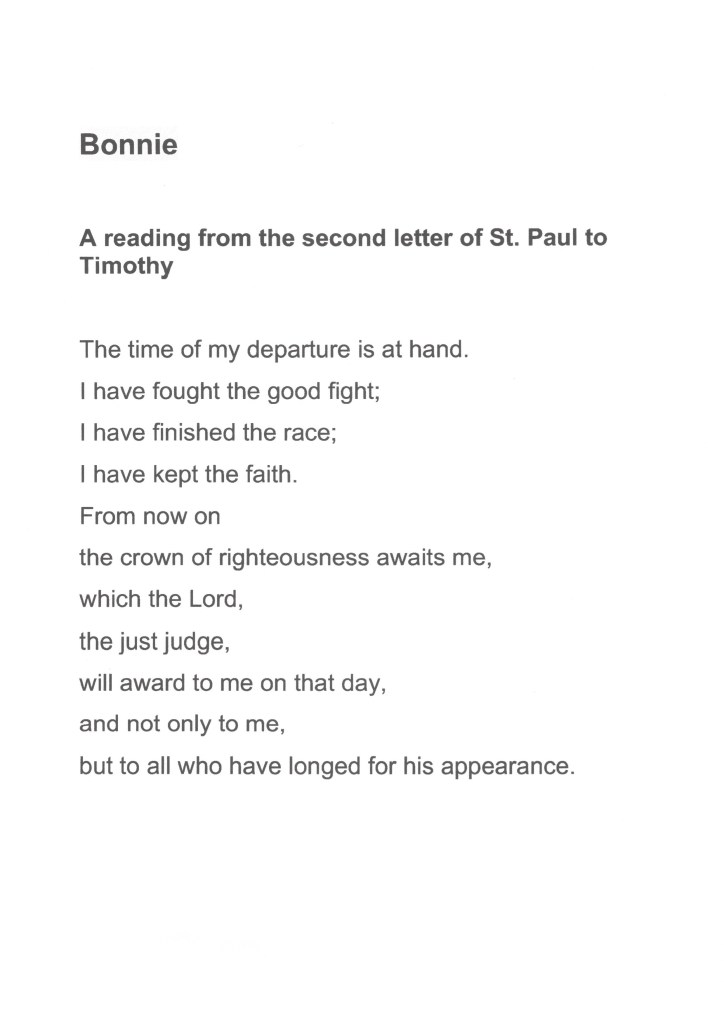
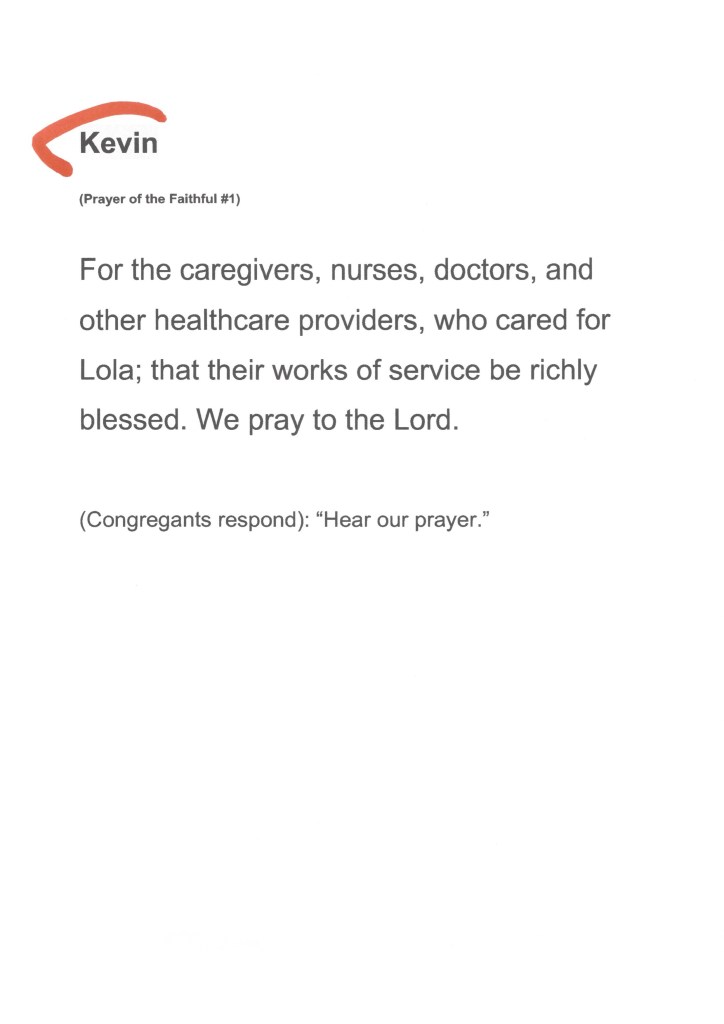
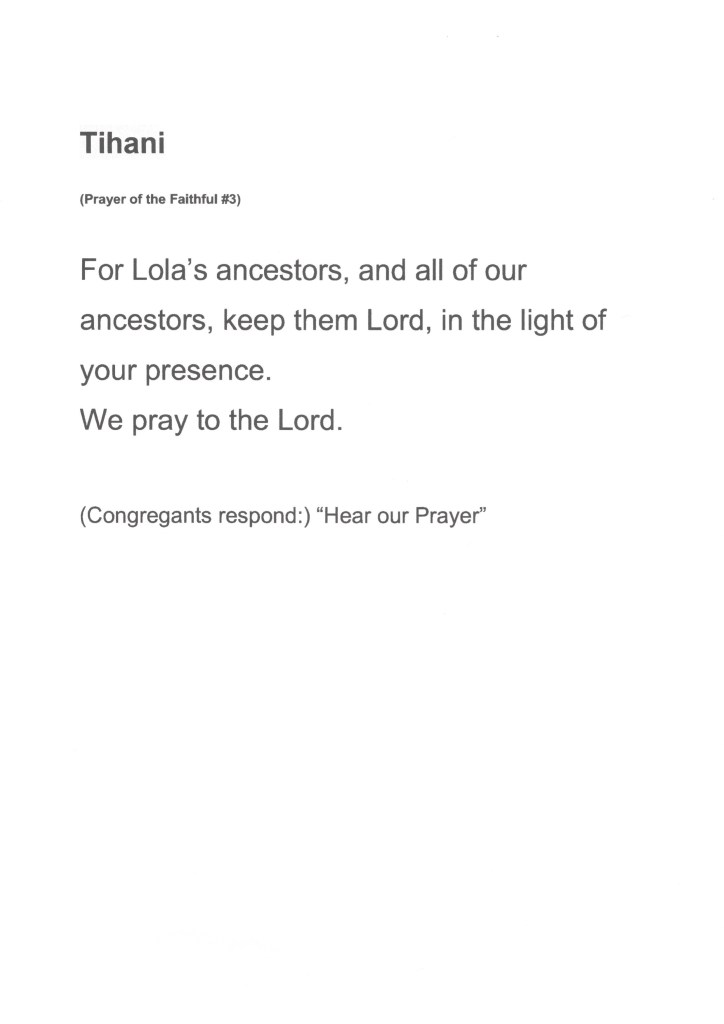
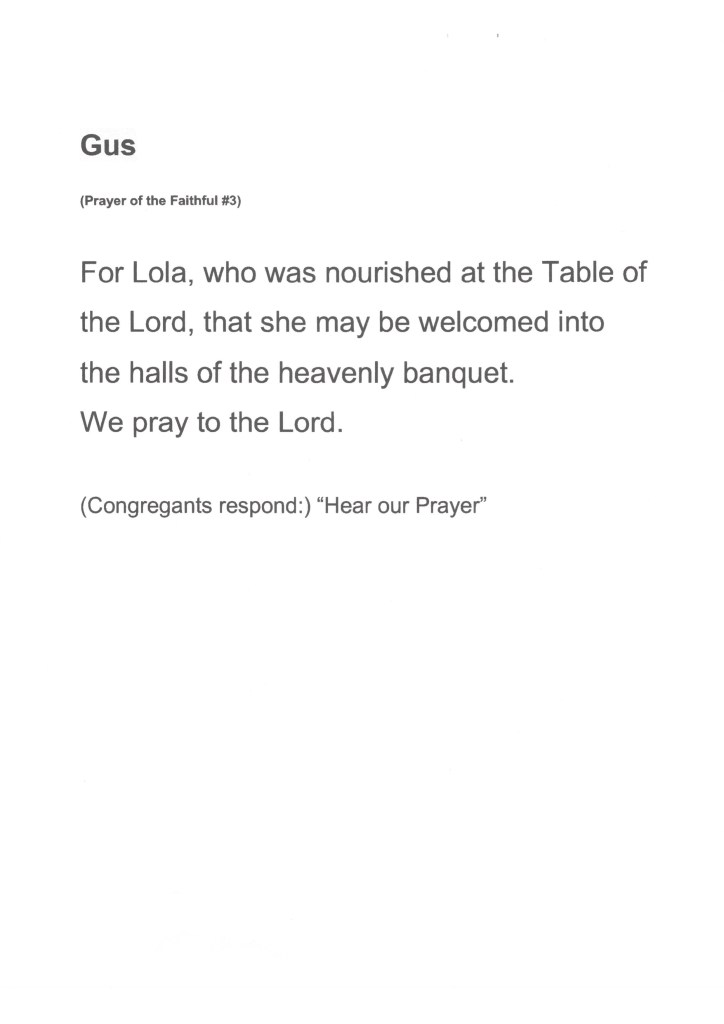
During the Liturgy of the Word portion of the Service, Hilda (aka Chi-Chi) and Bonnie, Lola’s two daughters, offered selections from the Bible’s Old Testament; and later, four of Lola’s grandchildren, Kevin, Aimy, Tihani, and Gus, each offered responsorial prayers. These are the pages from which they read at the podium.
Category: Uncategorized
-
Supporting The Underdog
Lola’s Values
- Galavanting
- Family
- Faith
- “Among my souvenirs”
- Supporting the underdog
-
Collection & Curation
Lola’s Values
- Galavanting
- Family
- Faith
- “Among my souvenirs”
- Supporting the underdog
-
Obituary
Theresa (“Lola”) Verzosa Santos Manzon (September 10, 1929 – May 16, 2023) was born in Manila, Philippines. Her birth name Teresita was “Americanized” when she was “naturalized” by immigration officials who could not pronounce it. To her relatives, she was affectionately known as Teret or Teresing. When she became a grandmother, she proudly took the name “Lola” (Tagalog for Grandma), and it stuck for the remainder of her life. She was the fourth of ten children of Mercedes (“Mamang”) and Elias (“Papang”), descendants of multiple lineages including the Mislang, Verzosa, de Jesus, Santos, Samonte, and Mariano clans.
Lola grew up mostly in Mamang’s hometown of Labrador in the province of Pangasinan (the land where salt is made). She was kinship-adopted for a time by Mamang’s younger sister Angela (Auntie Lilang). During the World War II, along with half of her siblings, she was evacuated to Laoag, Papang’s hometown, in the province of Ilokos Norte, where they stayed with Uncle Alberto (Dading), Auntie Dora, and her cousins. Later returning to Pangasinan, she attended a Catholic high school, The Adelphi College, where her classmates wrote “We hope to see you as a Mother Superior someday.” Lola also had a rebellious streak, and dreams beyond the convent. On one occasion, she risked her father’s wrath to sneak away with a friend to watch her matinee idol in his latest Hollywood film release.
Mamang, who was granted US citizenship for her service to Philippine President Quezon’s government-in-exile, established herself in San Francisco right after the War circa 1947 and sent for her children one at a time. At age 19, Lola immigrated in 1949 on a student visa, and joined her mother and older sister, Zenaida, at 763 Minna Street, South of Market, not far from the Little Manila neighborhood. She enrolled at what was then San Francisco State College. Though very intelligent, school just didn’t inspire her. She longed to work and, with that, to be independent. Photos from that period are abundant with family and social gatherings, outings in nature, picking fruit in orchards. It was here that she developed close, lifelong friendships, with Sofia and Sally, fellow Filipinas who could always be counted on for wise counsel and companionship.
In 1950, at one such social gathering, Lola met Mario Ramones Manzon, a Filipino from her home province. He was charming and a talented chef, and he joined the US Army which led to his US citizenship, and ultimately hers. They married on April 28, 1951, in Camp Roberts, California, where Mario was stationed.
Lola’s first born child, Antonio (Tony, whom she called Buging), arrived in October of that year. Her second baby, daughter Hilda, nicknamed Chi-Chi, came in December 1952. Her third child, Bonnie, was born in February 1958. Lola quickly became a devoted mother and hard-working military wife. Innately organized, she managed the household including the family finances.
In 1962, Mario was transferred to Naples, Italy, for a three-year tour. The Manzons grew close to other Filipino military families, becoming godparents for each other’s children. Lola was Ninang (Tagalog for Godmother) to George Prieto. They socialized at the NCO Club and vacationed modestly across Europe by car-caravan. Lola acclimated and became adept at negotiating with the local Neopolitan underground market, exchanging government-issue coffee and cigarettes for fresh produce and fish. For the next 60 years, she would routinely use certain Italian expressions: domani (“tomorrow”), grazie (“thank you”), Ciao! (“hello” and “goodbye”), subito (“right away”), and Mamma mia! (literally “My mother!” — an expression of amazement or surprise).
In 1964, Mario was transferred back to the States for successive tours at four different bases, including Fort Gordon in Augusta, Georgia, where he and Lola received their fourth child, John (Johnny), in March 1965. In 1971, stationed back at the Presidio (San Francisco), they bought their first house, like so many Asian and Latinx immigrant families, on Gellert Boulevard in Daly City, California.
It was also there in the Gellert house that Mario retired in September 1973 after 23 years of military service, and where he died suddenly in March 1980. Resilient to the core, Lola made the transition to widowhood and single motherhood, buoyed by her faith, and her family.
Lola lived in this house for 29 years. She worked in the Central Kitchen of the South San Francisco Unified School District, earning a pension after a decade, and moonlighted as a caregiver to seniors, encouraged by her long-time friend Sofia. Lola fell in love with cats and became a fierce supporter of animal rights. She enjoyed extended family with her closely held siblings, cousins, and in-laws – Zenaida, Romulo + Maxima, Fe + Tony, Vicky + Flor, Bobby, Ginny, Domingo, Elsa, Roger + Erly, Bitong and others – and their burgeoning families.
In November 1978, she officially became a Lola with her first grandchild, Kevin, who she nicknamed Koko, born in Hong Kong to Bonnie and then husband Kearn. Kevin was joined by younger twin siblings, Aimy and Tihani, in February 1980. Lola would visit as often as she could to help care for her grandchildren.
A few years later, Bonnie returned to the US and landed back in Lola’s home on Gellert. The twins followed when they were 4 years old; Kevin would join them in 1994 in order to finish high school stateside. Lola was heartened to welcome Bonnie and then husband Will and help raise her three oldest grandchildren under her roof. In December 1996, Tony and then wife Liz gave birth to Augustus (Gus), Lola’s fourth grandchild, whom she would enjoy visiting in New York City over the next several years.
In 2001, Lola began another chapter, moving alone to a new home in a senior community in Brentwood, California. She made friends among her neighbors there, enjoyed her independence, pursued hobbies, and continued her world travels. In the end, she visited 55 countries across five continents, and steadily added to her souvenir collections. Though she didn’t pursue her creative spirit in a formal way, her artist’s eye and sensibility were undeniable. She appreciated beauty, saw it everywhere in nature, in high art and folk craft alike. She paid attention to who made the art she loved, and as often as possible supported young, fledgling artists.
In July 2012, Lola welcomed her fifth grandchild, Andrés (who Lola nicknamed Chico), who was sent by many ancestors to Johnny and Mickey through adoption. Their relationship was full of tenderness and inside jokes. In 2017, Lola accepted the invitation of Johnny, Mickey, and Andrés to move in to their home. As her health declined, in 2020, Lola moved to the Carnelian Assisted Living community to receive the dignity and round-the-clock care she deserved, surrounded by highly skilled, culturally familiar, and deeply caring staff. She spent her final hours there with three of her children by her side.
Lola will be remembered most for her kindness, the way she would easily connect with just about anyone. Many will be grateful for her generosity – opening her home for long stays, willingly lending and gifting money, and commemorating weddings, graduations, and births with meaningful keepsakes. Grounded in her core value of education, Lola made sure all of her adult children and grandchildren completed college. She will be known for championing art and music, for her adventurous spirit, voracious travel, and opening to many cultures, including what became a multi-ethnic, multi-racial, queer-affirming family. She weathered life’s storms – war, immigration, widowhood, loss of roots, loss of loved ones, loss of health. Through the low points of her life, she found refuge with her family, in her passions, and her faith never wavered. Prayer remained constant.
Lola joins beloved Sofia, Sally, Auntie Lilang, Mamang, Papang, her siblings Zenaida, Honor, Romulo, Precita, Cirilo, Samuel, Leticia, and all her relatives and friends in the ancestor world, always to be remembered, cherished and celebrated. For her life we are deeply grateful.
-
Republika ng Pilipinas
1929 – 1949
Lola spent the first two decades of her life in the Philippines before emigrating to the United States a month shy of her 20th birthday.
She entered the world on Tuesday, September 10, 1929, at Philippine General Hospital in the Ermita district of Manila, the capital city of the Philippines. Her family home on Calle Alejandro VI (later changed to De los Santos Street) was in the Sampaloc district about three miles away from the hospital. Wikipedia refers to Sampaloc as the University Belt, or simply “U-Belt”, since it is home to numerous colleges and universities, including University of Santo Tomas, the oldest extant university in Asia.
Born Teresita Verzosa Santos, Lola was the fourth child of Mercedes Mislang Verzosa and Elias De Jesus Santos, who Lola called Mamang and Papang respectively. Her three older siblings were Zenaida (Zening), born in 1924, Honorato (Honor) born presumably sometime in 1925 or 1926, and Romulo (Romey) born in 1927.On her birth certificate, her first name Teresita is misspelled, with an extra “s” at the end, most likely due to a clerical error. Her birth date, which Lola always said was September 10th, seems to be mistakenly written as the 11th. She didn’t know the precise time of her birth and the above certificate leaves it a mystery.
[what was happening in the rest of the world — born 6 weeks before the stock market crash in the US?]
[this day in hx: https://www.britannica.com/on-this-day/September-10%5D
[picture in front of Auntie Lilang’s house at age 7]
[picture with friend on the S.S. Gordon]
THE WAR
DEATH OF SIBLINGS
Her older brother Honor (Honorato, named for…) drowned in Luneta Park.
DISPLACEMENT
Adoption by and loss of Auntie Lilang…
CAN WE INCLUDE A POWERPOINT?
Memory is spotty.
Nena [Teresito]
Acknowledge that deets are spotty for her early years.
She was born in Manila . . . The fourth of what would be ten children . . . Unofficial kinship adoption was a common practice, especially with large families.
Curious what languages she first heard, whether in the womb or after she was born. What did her older siblings were age 2, 4 and 6 speak to her in, especially the eldest, Zenaida, whom the family called “Zening”.
What language did Mamang was from Pangasinan — the land where salt is made — in Labrador, the next smallest town in the entire province which had a population of about 5,000 in 1929. There are Pangasinan words that even I remember her using. I knew the word “ambetel” as early or about the same time I learned “cold”.
Papang’s side of the family was from Laoag in the province of Ilocos Norte, where they spoke Ilokano.
At a certain point, Teresita, went to live with her beloved Auntie Lilang (explain which sister she is of Mamang’s). Kinship adoption. Lilang was a teacher who traveled from town to town, Teresita traveled with her. But as Lola told the story, at a certain point, when she was in Manila, a bridge washed out, not allowing her to return to Pangasinan.
Then she went to Laoag with half of her siblings. She remembers going to the freedom. Auntie Dora taught her how to work.
High school, she roomed with sister Fe, and cousin Emma or Fe?
USS General W. H. Gordon (AP-117) was a troop transport that served with the United States Navy in World War II. After the war, she was transferred to the US Army and served as USAT General W. H. Gordon. In the mid to late 1940s she sailed in trans-Pacific American President Lines passenger service with sister ship SS General Meigs. With the outbreak of the Korean War, she was reacquired by the Navy as a civilian-crewed Military Sea Transportation Service (MSTS) vessel, and redesignated USNS General W. H. Gordon (T-AP-117). She served again under the same designation in the Vietnam War.
General W. H. Gordon was launched under Maritime Commission contract by the Federal Shipbuilding and Drydock Company of Kearny, New Jersey, 7 May 1944; and commissioned, after being acquired by the Navy, 29 June 1944.
I’m thinking of writing a few paragraphs at the top about that particular period of Lola’s life, what might have been going on in the world, what forces impacted her, what influenced her decisions. Caption the photos we do have from that time.

-
Hello World!
Welcome to WordPress! This is your first post. Edit or delete it to take the first step in your blogging journey.


 "Ciao, Lola!"